Table and instant games6 min read
How much does the blackjack payout change from 3:2 to 6:5 or 1:1?
Our table pays 3:2 on a natural, a 0.9% house edge with basic strategy. At 6:5 it would be 2.1% and at 1:1 3.0%, measured over 40 million rounds.

Contents
Our blackjack pays 3:2 on a natural and, with basic strategy, keeps a house edge of 0.90%, a 99.10% return. The same rules at 6:5 would cost 2.14%, and at 1:1 2.97%. A natural is dealt in 4.745% of rounds, so a rule that touches only that hand still moves the edge by points. We measured 40 million rounds.
| Natural pays | Profit on a 10-coin stake | House edge (our other rules) | Expected loss per 1,000 coins played |
|---|---|---|---|
| 3 to 2 (our table) | 15 | 0.90% | 9.0 |
| 6 to 5 | 12 | 2.14% | 21.4 |
| 1 to 1 | 10 | 2.97% | 29.7 |
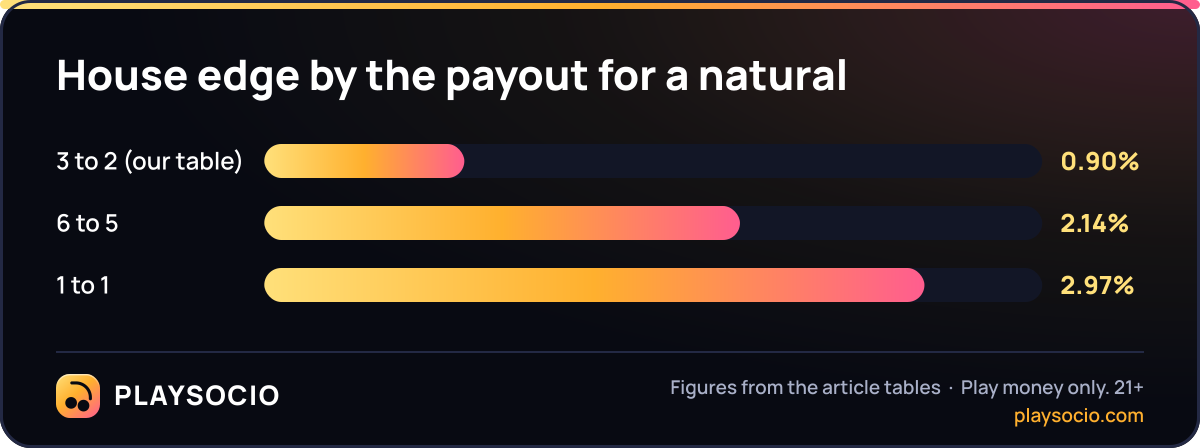
Our Blackjack pays the standard 3 to 2. Basic strategy covers which move to pick in each hand. The table counts a whole round, doubles and splits included, so the figures run a little under the cost per initial bet that the next section calculates.
Why does a rule about 4.5% of rounds cost so much?
A natural is paid in 4.527% of rounds (4.745% dealt, minus the 0.218% where the dealer also has one and the round pushes). Each time it is paid, 3:2 gives 0.5 of a stake more than 1:1, so the cost of 1:1 is 0.5 × 4.527% = 2.263% of the initial bet. From 3:2 to 6:5 the profit difference is 0.3 of a stake, which is 0.3 × 4.527% = 1.358%.
Measured per amount staked, the gaps are 1.24 points for 6:5 and 2.07 for 1:1 against our 3:2. They are a little smaller than the formula because doubles and splits raise the average stake per round to about 1.096 times the bet, and 1.358 / 1.096 = 1.24. The measurement and the formula agree.
Players feel 6:5 much less, because the difference shows in only one round out of 22. A blackjack on a 100-coin stake pays 150, 120 or 100 profit. The 30-coin shortfall hardly registers within a session, yet it shows in the balance after hundreds of hands.
What do our numbers show?
The headline figures come from one dedicated run. The production rules were played with basic strategy (it never takes insurance) for 10 million rounds in each of four runs.
| Run | Return at 3:2 (10 million rounds) |
|---|---|
| 20260101 | 99.047% |
| 777 | 99.109% |
| 31337 | 99.098% |
| 424242 | 99.150% |
| All four pooled | 99.101% |
Where the numbers come from: 4 runs × 10,000,000 rounds, stake 10 coins, November 2026. The spread between runs gives a standard error of about 0.02 points for the pooled return. The 6:5 and 1:1 figures re-price the same rounds exactly (only the paid naturals change), so they carry the same error. The natural frequencies are exact counts over the first four cards of an 8-deck shoe (32 aces, 128 ten-value cards of 416). A player who copies the dealer’s rule (hit to 17, no doubles, no splits) gets 94.07% in the same game.
We also tried several ready-made rule sets when choosing the game’s edge. Each was played with basic strategy, 300,000 rounds, so the error is larger.
| Rule set | House edge | Standard error |
|---|---|---|
| 6 decks, dealer stands on 17, 3:2, double after split, double on any | 0.43% | ±0.19 |
| 6 decks, dealer stands on 17, 6:5, double after split, double on any | 1.64% | ±0.18 |
| 8 decks, dealer hits soft 17, 3:2, double on any | 0.65% | ±0.19 |
| 8 decks, dealer hits soft 17, 6:5, double on any | 1.87% | ±0.18 |
| 8 decks, dealer hits, 1:1, double on any | 2.69% | ±0.18 |
| 8 decks, dealer hits, 6:5, double on 10-11, no split | 2.62% | ±0.18 |
| 8 decks, dealer hits, 6:5, double on 10-11 | 2.03% | ±0.18 |
| 8 decks, dealer hits, 1:1, double on 10-11 (our game before the change) | 2.87% | ±0.18 |
| 8 decks, dealer hits, 3:2, double on 10-11 (our game) | 0.78% | ±0.18 |
These rows come from 300,000 rounds per rule set. The 0.78% for our game sits within the error of the 0.90% from the long run. A gap under about 0.4 points between two rows is still within noise.
A few comparisons follow from the rows. Going from the 6-deck set (dealer stands on 17, double after split, 3:2, 0.43%) to the matching 8-deck set (dealer hits soft 17, no double after split, 0.65%), the three changes together cost about 0.2 points. Limiting doubling to 10 and 11 costs about 0.1 to 0.2 points at 3:2 on these samples, and banning splits as well costs 0.6 points at 6:5 (2.62% against 2.03%). The blackjack payout is the biggest lever: 3:2 against 1:1 is worth more than all the other changes combined.
How is the payout handled in practice?
A 6:5 payout needs a stake that is a multiple of 5, because 1.2 times the stake must come out whole. The same goes for insurance, which costs half the stake. In the engine this is set by the bet step (betStep): in our game it is 10, so a 10-coin bet returns 25 coins on a natural, 15 of them profit, and every payout is a whole number of coins.
Before you sit at a table marked 6:5, read the payout for blackjack. It takes one line of the rules to see whether the edge is near 1% or near 2%, and no strategy will recover the difference.
What should you remember from the numbers?
The edge is the sum of many rules: how many decks, what the dealer does on 17, when doubling is allowed, whether you can double after a split, and how much blackjack pays. The same game with the same cards can cost anywhere from 0.4% to 3%. Insurance is another single decision that moves the number, and the article on insurance works through it.
What does it look like in a session of 200 hands?
You play 200 hands at a 100-coin stake, 20,000 coins played. You will be paid for about 9 blackjacks (200 × 4.527% = 9.05). At 3:2 each pays 150 profit, at 1:1 it would pay 100. The difference is 50 coins per blackjack, about 453 coins per session, which is 2.3% of the amount played. The standard deviation of such a session is near 1,560 coins, so the rule difference is under a third of the random swing. You will not spot it by eye in one session. Over thousands of hands it dominates the result.
How much does one blackjack win with each payout?
If you play 100 blackjacks at a stake of 100, a 3:2 payout brings 15,000 profit, 6:5 brings 12,000 and 1:1 brings 10,000. Between 3:2 and 1:1 the difference is 5,000 coins per 100 blackjacks. A blackjack is paid in 4.527 rounds in 100, so that corresponds to about 22,600 coins per 10,000 hands at the same stake (1,000,000 played, which is 2.26%).
Coins have no cash value, and the game is for adults aged 21 and over. The figures were produced in November 2026 with the simulations described above. If you find an error, tell us and we will correct it with a new date.
Sources
Frequently asked questions
What does a 3:2 payout mean in blackjack?
If you get a blackjack (an ace and a ten-value card as your first two cards), you win 3 coins for every 2 you staked. With a 10-coin stake you get 15 profit, with 6:5 you get 12 and with 1:1 you get 10.
How often does a blackjack come?
In our engine a natural is dealt to the player in 4.745% of rounds, about once in 21 rounds. It is paid in 4.527% of rounds, because in 0.218% the dealer has one too and the round is a push.
What payout does the game's blackjack have?
3 to 2, the standard rate, together with 8 decks, a dealer who hits soft 17 and doubling on hard 10 or 11 only. The house edge with basic strategy is 0.90%, so the declared return is 99.1%.
If only the payout changes, does the strategy change?
Hardly at all. The payout of a natural affects the cost, while the hit, stand, double and split decisions stay almost the same.
About the author
Game Math Desk Probability and simulation
The people who build and check the maths of our games: paytables, reel weights, RTP simulations and volatility.
Coins have no cash value. 21+ only. Play money only, no real-money gambling, no prizes, no cash-out.