Responsible play guides6 min read
How do you set time and coin limits, and what number should you pick?
How our daily and weekly coin loss limits, daily time limit and reminders work, with expected-loss arithmetic to help you choose a number that fits you.
By Playsocio Editorial Team Updated:

Contents
You set limits in the account’s responsible play settings: a daily and a weekly net coin loss limit, a daily time limit, and a reminder interval. Lowering or setting a limit works immediately, raising or removing one waits 24 hours. With a hypothetical 98% RTP, 100 bets of 100 coins cost about 200 coins on average.
| Setting | How it works |
|---|---|
| Daily loss limit | Net coins lost in a day; the game stops accepting bets at the limit |
| Weekly loss limit | Net coins lost in a week |
| Daily time limit | Minutes of play per day |
| Reminder | A message after the interval you choose |
| Lowering or first setting | Immediate |
| Raising or removing | Takes effect after 24 hours |
| Overshoot | A loss limit can be passed by at most one bet |
Everything here concerns play money: coins have no cash value and the site is for adults aged 21 and over. Still, time, mood and sleep are real, and a limit is a way to decide those things in advance. The responsible gaming page lists the tools in one place.
Why set a limit before you play?
A limit is a decision taken while calm. During a session, the same decision is harder, because a loss makes continuing feel more urgent, a pattern described in chasing losses. A limit fixes the rule in advance and the 24-hour wait protects it from impulse.
Nobody needs a reason to set a limit. Many people set one the way they set a phone alarm, to keep an evening from running longer than planned.
How do the limits work in detail?
The loss limit counts net coins lost, meaning wins reduce the count. Because the check happens before a bet, the last bet can take you past the limit, by at most the size of that one bet. If your stake is 500 coins and your daily limit is 600, the worst case ends the day 500 coins past it, so pick limits that are several stakes wide.
The time limit counts time between bets as play time when the gap is up to 5 minutes. If you leave the game open and walk away for an hour, that hour is not counted as a continuous session, but the time you actually play is. The reminder is a prompt only; you decide whether to stop.
Breaks work differently from limits. A break of 1 hour, 24 hours, 7 days or 30 days cannot be shortened once started. More on that in breaks and self-exclusion.
What do our numbers show?
To choose a coin limit, it helps to know what a session costs on average. For bets of equal size, the expected loss is stake times number of bets times the house edge (1 minus the RTP).
| Setup | Expected loss per 100 bets |
|---|---|
| 100 coins per bet, hypothetical 97% RTP | 300 coins |
| 100 coins per bet, hypothetical 98% RTP | 200 coins |
| 10 coins per bet, hypothetical 98% RTP | 20 coins |
How we got these numbers: the expected-loss figures are exact arithmetic from a hypothetical RTP (stake x bets x (1 minus RTP)), November 2026. They are examples, not figures for any game of ours. We also simulated 20,000 sessions of 300 bets of 10 coins on a 1,000-coin balance, with a 49% chance of doubling the stake (a bet with a hypothetical 98% RTP). With flat stakes, 0% of sessions ran out of coins and the median ending balance was 940 coins (the expected 1,000 minus 300 x 10 x 0.02). When the stake doubled after every loss, 60.7% of sessions ran out. These are averages of a simplified model, not predictions for any single session.
A coin limit works best when it is a multiple of the expected loss, because hopes make poor yardsticks. If 100 bets of your usual stake cost about 200 coins on average, a daily limit of 2,000 coins covers about 1,000 bets on average, while a swing of several thousand in a lucky or unlucky stretch is entirely normal. A smaller number is also easier to keep.
How do I choose my numbers?
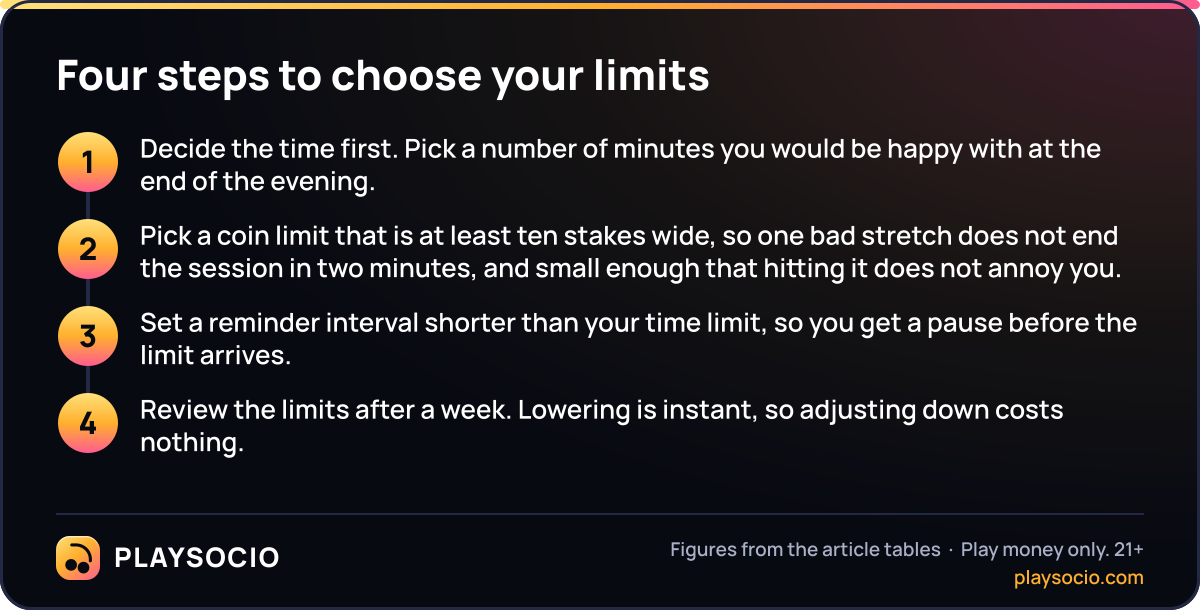
- Decide the time first. Pick a number of minutes you would be happy with at the end of the evening.
- Pick a coin limit that is at least ten stakes wide, so one bad stretch does not end the session in two minutes, and small enough that hitting it does not annoy you.
- Set a reminder interval shorter than your time limit, so you get a pause before the limit arrives.
- Review the limits after a week. Lowering is instant, so adjusting down costs nothing.
If you keep wanting to raise a limit, that tells you something. The 24-hour wait gives you a day to ask yourself why. For more on spotting that pattern, read signs of problem play.
What should I do when I reach a limit?
When the game stops accepting bets, the day’s session is over. Close the game, do something that has nothing to do with it, and look at the limit the next day with a clear head. If you find yourself looking for a way around the limit, treat that as a signal to read signs of problem play and consider a break from the settings. A limit that only ever gets raised has stopped doing its job.
What limits cannot do
Limits control coins and time inside this site. They do not stop you from playing elsewhere, and they cannot judge your mood. For play outside this site, the NHS lists self-help steps such as blocking apps, the GamStop scheme in Great Britain, and asking your bank to block gambling payments. We do not provide help ourselves. If play stops feeling like entertainment, where to find help lists independent organisations we checked on their own sites.
Correction note
If a number on this page does not match what you see in the settings, tell us and we will check and correct the article with a visible modified date.
Sources
Frequently asked questions
Can I raise a limit straight away?
No. Setting a limit for the first time or lowering it takes effect immediately. Raising or removing a limit waits 24 hours, so a decision made in the heat of a session cannot undo your own protection.
Can a loss limit be passed?
By at most one bet. The limit is checked before a bet, so the bet that crosses it can still be played. Choose a limit that leaves room for your stake size.
What counts as play time?
The time between your bets counts as long as the gap is up to 5 minutes. A longer pause ends the session, and the start of a new session is counted with a fixed first-bet allowance.
Do limits make a game safer to play?
Limits help you keep control of time and coins. They do not change the odds of any game. Coins have no cash value, but time and mood are real, which is why a time limit is as useful as a coin limit.
About the author
Playsocio Editorial Team Writers and game designers
The team that writes the guides and designs the games. We explain how games of chance work in plain language.
Coins have no cash value. 21+ only. Play money only, no real-money gambling, no prizes, no cash-out.