Guides and glossary11 min read
Are free casino games online really free, and how do they differ?
Free casino games online come in five models: social casino, demo, offers with terms, sweepstakes and unlicensed sites. Here is how to tell them apart.
By Playsocio Editorial Team Updated:
Contents
- What does “free casino” mean when you search for it?
- What is a social casino and what can it not do?
- What is a demo mode at a licensed operator?
- What are offers that need no payment up front, and why don’t we make them?
- How do sweepstakes models work, and why aren’t they ours?
- Which signs point to an unlicensed site?
- How do you tell which model you are on?
- What can free play teach you, and what can it not?
- What do the numbers show?
- How do you read the terms of an offer before accepting it?
- What are the common mistakes?
- How do you play responsibly, even for free?
- Try it without money
Free casino games exist; free money does not. A social casino gives you virtual coins with no value, such as the 2,500 coins a new account gets here at once, and nothing can be cashed out. Offers that need no payment up front from operators who take real money are a different product, with terms attached.
| Model | What you play with | Can money come out? | What it costs |
|---|---|---|---|
| Social casino (us) | Virtual coins | No | Time |
| Demo at a licensed operator | Trial balance | No | Time |
| Offer with terms | Credits or free spins backed by real money | Only under conditions | Possibly money |
| Sweepstakes | Two currencies, one redeemable | Yes, under conditions | Possibly money |
| Unlicensed site | Anything | Uncertain | Possibly money and data |
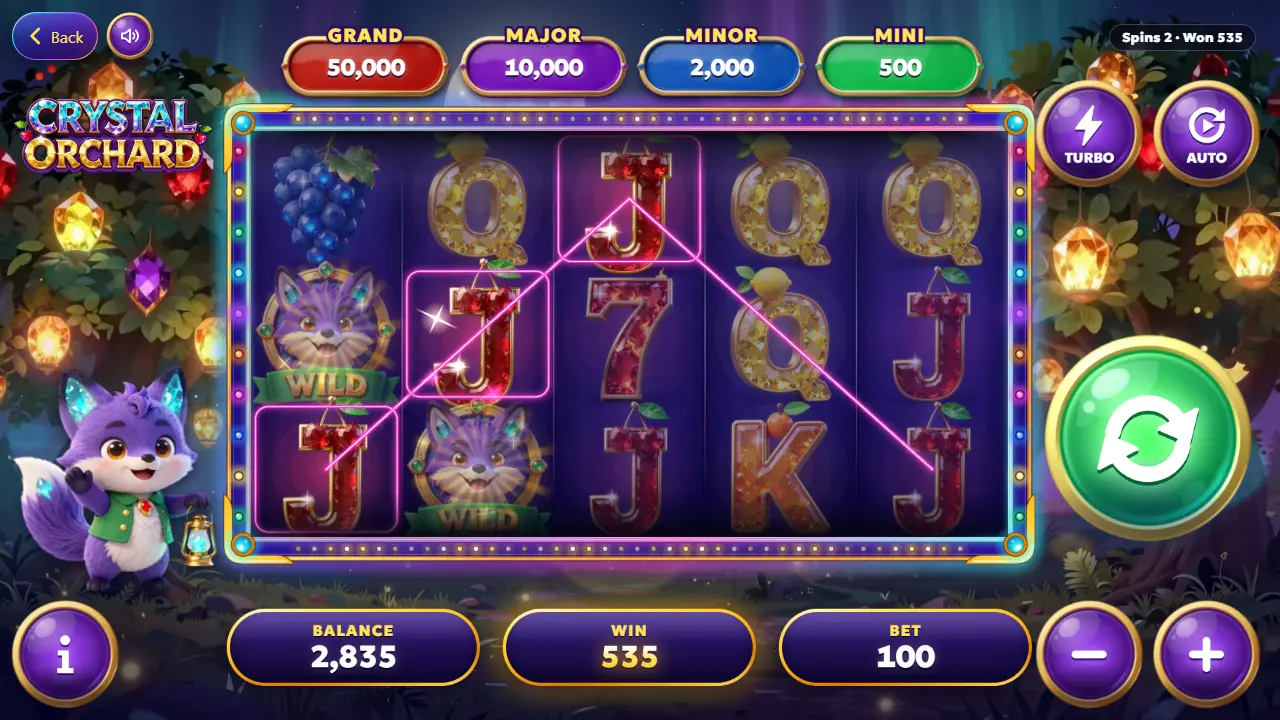
Someone typing “free casino” into a search box may mean any of these five. If you want the definition first, read what a social casino is. Here we put the five models side by side so you know which one you are on before you press the first button, and you can try the first one in Crystal Orchard.
What does “free casino” mean when you search for it?
The phrase has no single meaning. One reader wants to pass the time on a slot without spending anything. Another hopes for a starting amount to play “for free” that might turn into cash. The two searches lead to very different sites, and the second is where the trouble starts.
So the answer starts with one question: what do you receive if you win? If the answer is “a number on the screen”, you are in a social casino or a demo. If it is “money I can withdraw”, there are terms, and they have to be read.
What is a social casino and what can it not do?
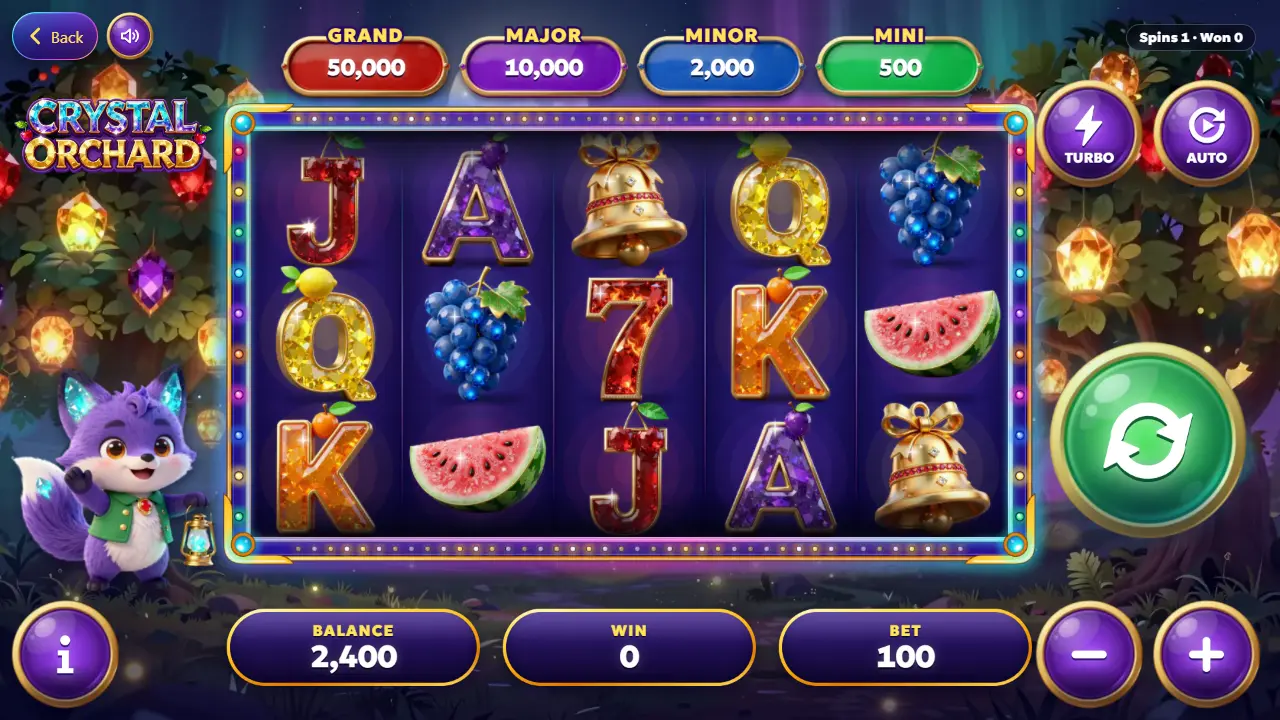
A social casino is free to join and played with coins that have no cash value. On Playsocio coins cannot be withdrawn, sold to other players or swapped for prizes. The age limit is 21+, and the purpose is entertainment.
One thing is worth knowing about the economy: the coins you start with are finite. The settings we read from our server (November 2026) give a new account 2,500 coins at once. After you verify your email and opt in to the newsletter, a one-time welcome claim adds 10,000 coins, 550 free spins (they expire after 30 days), 10 minutes of Free Spin Time and a 500-coin free bet for virtual sports. Daily rewards run on a 30-day cycle of 800 to 1,200 coins a day, with bigger milestone days at 2,400, 4,000, 4,800 and 9,600, and add up to 46,720 coins for someone who logs in every day. When your balance falls under 1,000, a refill of 40 to 240 coins is available once a day. Those numbers change when the settings change; the full picture is in the article on the coin economy.
There is also something we owe you plainly. In the apps you can optionally buy coin packs. Bought coins are play money like all the others: they have no cash value and cannot be cashed out or transferred to another player. On the web the store is in test mode and charges nothing until a payment provider is connected, and this article will be corrected with a visible date when that changes.
What is a demo mode at a licensed operator?
Many licensed operators let you try a game on a trial balance, without using your own money. It is the closest cousin of our model, with one difference: the demo sits next to a service that takes real stakes, and the “play for money” button is often two taps away.
The UK Gambling Commission treats this seriously. Since May 2019 it has required licensees to verify a customer’s age before that customer can open their free-to-play games, and it notes that simply typing in a date of birth is not enough. The July 2019 notice is on the Gambling Commission site. What that means for you: a demo is not neutral, and a serious operator handles it like a real game.
What are offers that need no payment up front, and why don’t we make them?
A free-credit promotion is a sum of credits or a number of spins that an operator taking real money hands to a new customer before the customer has paid anything. The credit is paid for with your details, your registration and, above all, your acceptance of the terms.
The terms are the substance of the offer. They usually include:
- A wagering requirement: you must play the amount through a set number of times before you can withdraw anything.
- A cap on winnings: whatever you win, only a small amount can be cashed out.
- Restricted games and time: the offer applies to chosen titles and expires.
- Identity verification: documents are requested before a withdrawal.
We do not offer these, for a simple reason: we neither accept nor pay out money, so there is nothing to withdraw. Coins given here are coins, and we say so in the first line. If you meet such an offer elsewhere, there is one check: find the terms and read all of them before pressing accept. For licensed providers in Greece the reference point is the Hellenic Gaming Commission, whose site has sections on licences and responsible gaming. For what the law says, do not rely on a blog post: read the regulator, or ask a lawyer.
How do sweepstakes models work, and why aren’t they ours?
In a sweepstakes model, found mainly in US markets, the player holds two currencies: one that is bought and only used for play, and a “gift” currency that comes with it and can be redeemed. Legally it is framed as a prize draw rather than a bet. In practice the second currency is money under another name.
We do not do this. Playsocio has one currency and it cannot be redeemed. If a platform has a second currency that converts into money or prizes, treat it as a service involving real money and apply the checks in the next section.
Which signs point to an unlicensed site?
The HGC site links to a list of unlicensed websites. Before you get that far, look for these signs:
- It does not say who operates it, or its licence cannot be checked with an official body.
- It promises that winning is certain, or that “you cannot lose”.
- It asks for a payment to “unlock” or withdraw free winnings.
- It asks for ID and a card before it tells you the terms.
- The terms are hidden, or only exist in a language you do not read.
- It pressures you with a countdown or messages through a chat app.
One of them is enough to stop. The check the HGC points to is looking the site up in its list of licensed providers on its own page, not trusting a logo in the footer.
How do you tell which model you are on?
Five questions are enough, and the answers usually sit in the terms of use and in the shop.
| Question | Social casino | Offer with terms |
|---|---|---|
| Can I withdraw money? | No, nowhere | Yes, if I meet the terms |
| Is there a wagering amount to complete? | No | Usually yes |
| Does it ask for ID or a bank? | Not to play | Yes, before withdrawal |
| Are there two currencies, one redeemable? | No | Yes in sweepstakes |
| Does it say outright that coins have no value? | Yes | Rarely |
If you answer “yes” to “can I withdraw money”, you are on a service involving real money, whatever the headline says. See also play money versus real money for the same distinction seen from the wallet.
What can free play teach you, and what can it not?
It can teach rules: how a blackjack hand is dealt, what a pay line is, how the checkers move in tavli. It can show what a run of swings looks like. And, most usefully, it shows that the average beats the streaks, as we explain in house edge, RTP and volatility.
It cannot show how you will react when you lose money. Stakes change behaviour: the same person decides differently with 100 coins than with 100 euros. We have no figure of our own for that difference. We do not cite a study on whether free play leads to later play for money, because we could not find one we could verify. The Gambling Commission does ask for age checks on free play too.
A maths example with a made-up figure: at a stake of 100 coins and an RTP of 95%, the expected loss over 100 spins is 500 coins. The same formula applies in any currency; only what is lost differs, and any single session can end far from the average.
What do the numbers show?
Take the size of the welcome claim, 10,000 coins, as an example wallet. How long it lasts depends first on your bet, and then on luck. This table is plain division, with no assumption about any game’s results.
| Bet per spin | Bets in a 10,000-coin wallet | What it means |
|---|---|---|
| 80 coins | 125 | A long session even if the results lean against you |
| 100 coins | 100 | A medium session |
| 200 coins | 50 | A short session that can end quickly |
Volatility changes the picture. A low-volatility slot pays small amounts often, so a wallet tends to shrink slowly. A very high-volatility slot can go quiet for a long stretch and then pay once, so two players with the same wallet and the same bet can end a session in very different places. The two simply feel different to play.
Engine data: the wallet and reward figures come from the server’s default economy settings as read in November 2026; the bets-per-wallet table is arithmetic, with no simulation behind it. Game results come from a server-side shuffle and random number generator, never from the browser. No payout or hit-rate figures for our games are published in this article.
How do you read the terms of an offer before accepting it?
Read in this order:
- Who offers it? Does it hold a licence? Check the regulator’s list.
- What exactly do you get: money, credits or spins? At what value per spin?
- What must you play: how many times the amount, in which games, within how many days?
- What can you withdraw: is there a cap on winnings?
- What do you give in return: personal details, permission for messages, ID?
If one of the five is not stated clearly, treat it as a no. The same questions work for any “gift” from an app.
What are the common mistakes?
- Confusing “free to play” with “free to win”. The first can be true; the second rarely is.
- Assuming a demo predicts a result with money. A good run in a demo says nothing about the next one.
- Raising the stake to catch up with a shrinking wallet. In coins or not, the game’s edge does not change.
- Giving a card to “confirm” a free account. A free game does not need payment details to start.
- Trusting the licence logo on the site itself. Check it with the regulator.
How do you play responsibly, even for free?
Coins have no cash value and the platform is for adults, 21+. The time you spend is real, though. Set a session length before you begin, see how to set limits and read the signs of problem play. If you are worried about your own play or someone close to you, see where to find help. For age and account safety there is the article on 21+, and for whether the games are fair, are online casino games rigged. BeGambleAware (begambleaware.org) has support material in English.
If you do not enjoy it, stop.
Try it without money
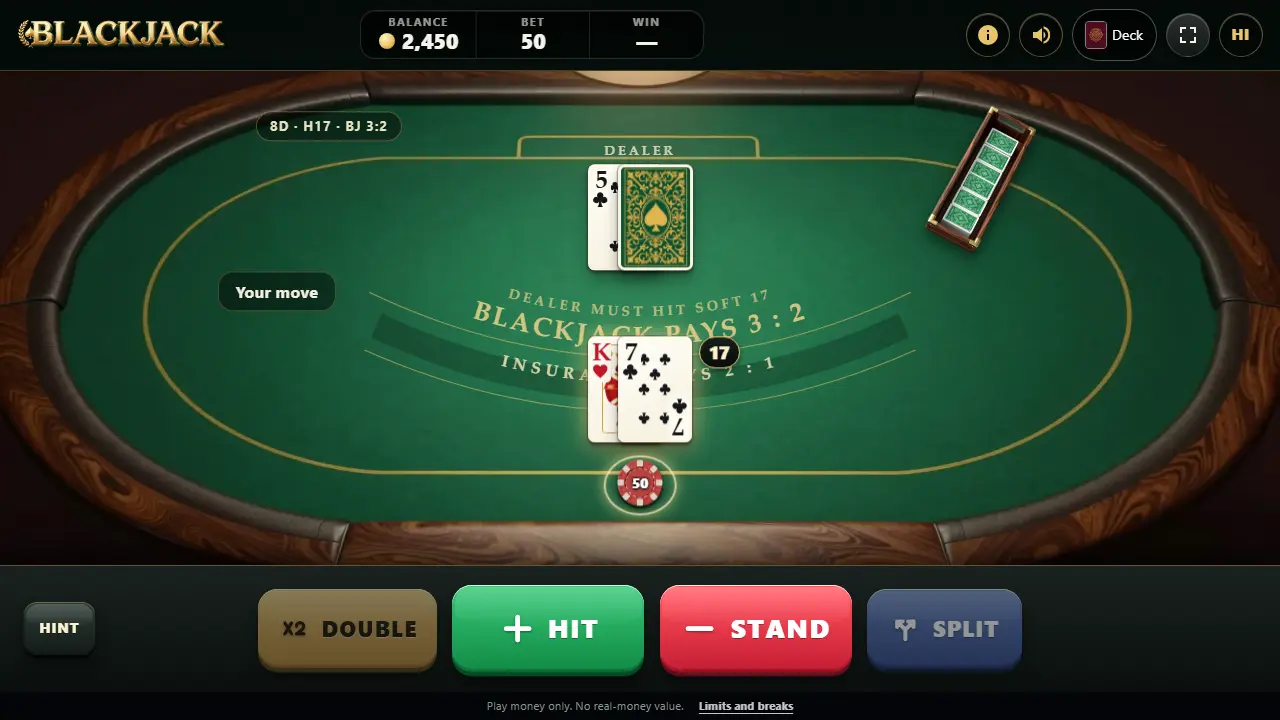
If you want to see how a game works with coins, blackjack and roulette show their rules and payouts on screen. It is free, with coins that have no cash value, for adults 21+.
Create a free account or Play free. Free, with virtual coins that have no cash value. 21+.
Sources
Frequently asked questions
Is there a casino that pays out real money without my paying anything?
Not here. Coins on Playsocio have no cash value and cannot be exchanged for money or prizes. Licensed operators that take real money sometimes run free-credit promotions, but these almost always come with wagering conditions and caps, so they are not free money. Read the terms before you accept anything.
What is a social casino?
A platform with casino-style games played with virtual coins. Joining is free and the coins cannot be withdrawn. Our definition and how we apply it are in the article on what a social casino is.
Are free games run on the same odds as games played for money?
Often the same kind of maths, but not necessarily the same numbers, so check the rules and paytable each game shows on its own screen. Either way, you behave differently when no money is at stake.
How can I tell a licensed site from an unlicensed one?
The Hellenic Gaming Commission (HGC) site has a check for whether a website is on its list of licensed providers, and a list of unlicensed sites. Check there, not in a badge at the bottom of the site itself.
If I only play for free, am I safe from problem gambling?
Not necessarily. Sounds, near misses and big wins produce real feelings even with coins. If you play longer than you meant to or hide how long you play, take a break and see where to find help.
What should I do if a site asks for a payment to unlock free winnings?
Stop. A free game does not need a payment to hand over winnings that are supposedly yours. It is one of the main signs of a scam.
About the author
Playsocio Editorial Team Writers and game designers
The team that writes the guides and designs the games. We explain how games of chance work in plain language.
Coins have no cash value. 21+ only. Play money only, no real-money gambling, no prizes, no cash-out.