Virtual sports and coin betting6 min read
How do betting odds convert into a probability?
Decimal, fractional and American odds with the formula 1 / odds, a conversion table and a worked example from our own virtual football league.

Contents
A decimal price of 2.50 implies a 40% chance, because the implied probability is 1 divided by the odds. The formula holds for every decimal price. The price also carries a margin, so the implied chances of all the outcomes of one match add up to a little more than 100%.
| Decimal | Fractional | American | Implied probability |
|---|---|---|---|
| 1.10 | 1/10 | -1000 | 90.9% |
| 1.25 | 1/4 | -400 | 80.0% |
| 1.50 | 1/2 | -200 | 66.7% |
| 1.80 | 4/5 | -125 | 55.6% |
| 2.00 | 1/1 | +100 | 50.0% |
| 2.50 | 3/2 | +150 | 40.0% |
| 3.00 | 2/1 | +200 | 33.3% |
| 4.00 | 3/1 | +300 | 25.0% |
| 6.00 | 5/1 | +500 | 16.7% |
| 11.00 | 10/1 | +1000 | 9.1% |
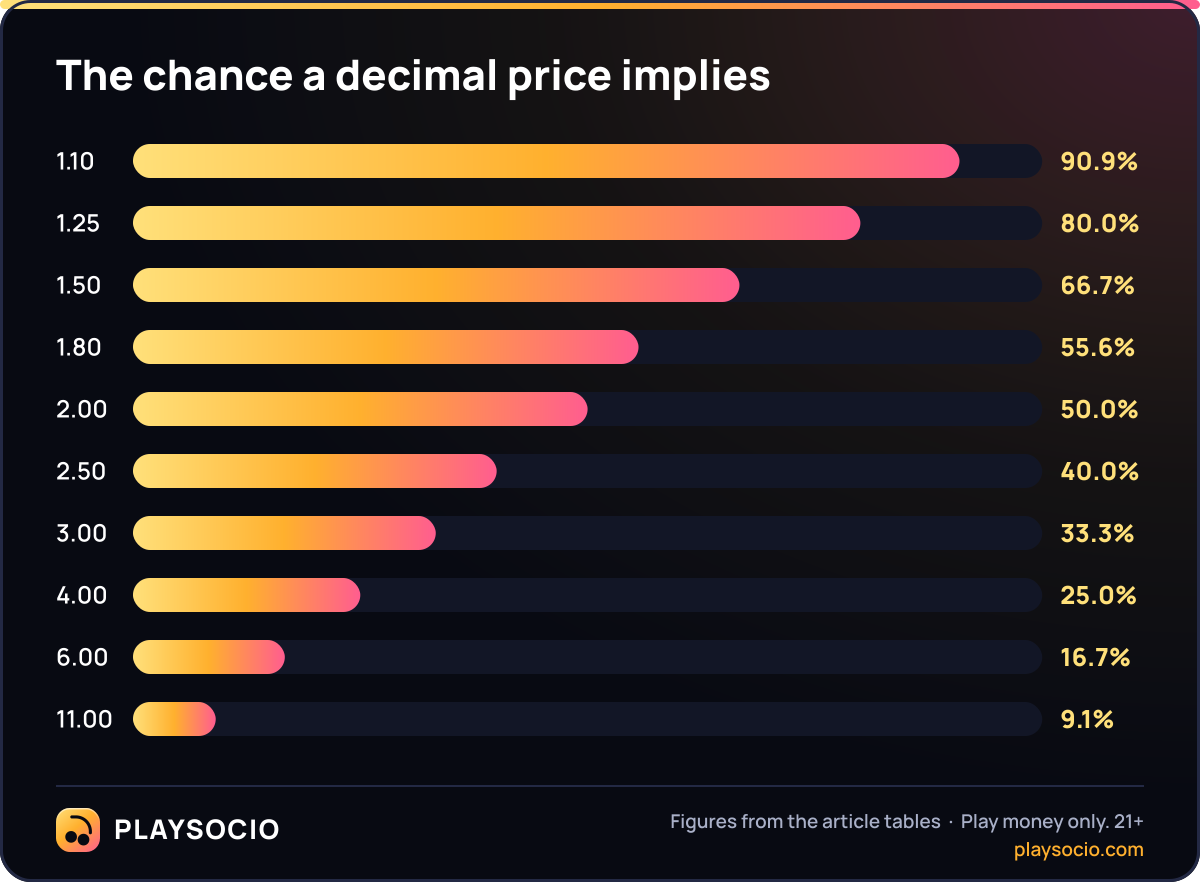
Every example here uses play-money coins, which have no value outside the game. You will find the prices in coin betting and in virtual sports. The article on the margin picks up where this one stops.
How do you read a decimal price?
A decimal price is the multiplier of your stake, stake included. Put 100 coins on 2.50 and a winning selection returns 250: your 100 plus 150 profit. A losing selection returns nothing. In our virtual book prices start at 1.01, go up to 1,000 at most, and always have two decimals.
The probability behind a price comes from inverting it. 2.50 gives 1 / 2.50 = 0.40 and 1.25 gives 0.80. The closer a price is to 1, the more likely the selection is thought to be.
How do fractional and American odds work?
Fractional odds show profit relative to stake. 3/2 means 3 profit for every 2 staked, which is 2.50 in decimal. To convert, subtract 1 from the decimal price and simplify: 2.50 − 1 = 1.50 = 3/2.
American odds have two branches. +150 says how much you win on a stake of 100, so it covers decimal prices from 2.00 up: +100 × (decimal − 1). −200 says how much you must stake to win 100, so it covers prices below 2.00: −100 / (decimal − 1). The two branches meet at 2.00, written +100.
All three formats carry the same information. Local habit decides which one you see, and the underlying price is the same.
How clean is the probability you get from a price?
It is not clean, because the price includes a margin. Take a match from our virtual league, Redmoor United against Bluecrest Albion. The 1X2 prices are 1.98 for the home side, 3.94 for the draw and 3.53 for the away side.
| Selection | Odds | 1 / odds | After normalising | Model probability |
|---|---|---|---|---|
| Redmoor United (1) | 1.98 | 50.5% | 48.5% | 48.5% |
| Draw (X) | 3.94 | 25.4% | 24.4% | 24.4% |
| Bluecrest Albion (2) | 3.53 | 28.3% | 27.2% | 27.2% |
| Sum | 104.2% | 100% | 100% |
Divide each implied chance by the sum, 104.2%, and you recover the model’s probabilities to one decimal place. This is the simplest way to strip out a margin and it is called normalising. It works well when the margin is spread in proportion across the selections, which is how our prices are built.
What do our numbers show?
We ran the pricing code of the sportsbook package over the 132 distinct pairings of one season of the virtual league (12 clubs, 22 matchdays, 6 matches per matchday).
Where the numbers come from: 132 matches of the virtual league, priced with the Poisson model of our virtual sportsbook (November 2026). In each match we took the favourite of the 1X2 market, meaning the shortest price. Its average price is 1.934 and its chance from the model averages 51.6%. Inverting that average price gives 51.7%, which looks like no margin at all, but the shortcut misleads: the average of 1 / odds is higher than 1 / (average odds). Match by match, the favourite’s implied chance sits about 4% above its model chance in relative terms, as in the example below (50.5% against 48.5%). This is a calculation on the model with no random sampling, and it is not an observation of players.
The second thing to notice is that the sum of 1 / odds in the example, 104.2%, sits slightly above the 104.0% that a 4% margin implies. Rounding down explains the difference: prices can only shrink, never grow.
How do you use this in practice?
- Before you look at what a selection pays, write down the chance the price implies. A 4.00 means “one in four”.
- To compare two prices, convert both to probabilities. 3/1 and 4.00 are the same price.
- Remember that all selections of a match add up to more than 100%. If two selections seem to “cover” a match, do the sum before you conclude anything.
Which mistakes are most common when reading odds?
The first mistake is to read the price as profit. At 2.50 with a stake of 100 coins the profit is 150, and the 250 is the total return. The second is confusion between formats: fractional 5/1 corresponds to decimal 6.00 and not 5.00, because the fraction shows only the profit.
| If you read | What it really is | What changes in the probability |
|---|---|---|
| 5/1 as 5.00 | 6.00 | 16.7% instead of 20.0% |
| 1.98 as the same as 2.00 | 1.98 implies 50.5% and 2.00 implies 50.0% | 0.5 percentage points |
| A sum of 104.2% as “clean” probabilities | 100% after normalising | 4.2 points of margin |
The third mistake is to treat a difference of one hundredth as trivial. On the home win, with a probability of 48.47%, a price of 1.98 gives an expected return of 0.9597 per coin and a price of 2.00 gives 0.9694. The difference is 0.0097 per coin, about 97 coins over 100 bets of 100 coins. That is why the hundredth that rounding cuts off is not negligible, especially when a bet is repeated many times.
How do you repeat the calculation?
The numbers in this article come from an exact calculation of the virtual book, which takes about 20 seconds and gives the same figures every time. If the book’s settings change, the tables change with them and the article is rewritten with a new modified date.
The limits of this article: the prices belong to the virtual book and are not forecasts of any real match. A short price does not guarantee a win, and a long one does not guarantee a loss. If a number here differs from the one on the game page, the game page wins and we correct the article and note the change on this page. An earlier wording of the favourite paragraph compared the inverted average price with the model chance; we replaced it because the shortcut hides the margin. The game is for 21+ and the coins are play money with no cash value.
Sources
Frequently asked questions
What does a price of 2.00 mean?
That the selection is priced at a 50% chance. Stake 100 coins and if it wins you get 200 back: your 100 plus 100 profit.
Why do the chances of one match add up to more than 100%?
Every price carries a margin. In the 1X2 market of our virtual matches the declared margin is 4%, so the sum of 1 / odds comes out near 104%.
Which odds format does coin betting use?
Decimal. The other two formats are explained here so you can read material from elsewhere, but every price on our pages is decimal with two places.
Does a short price mean the selection will win?
No. It means the model rates it as more likely than the others. In our data the favourite of a 1X2 market wins 51.6% of the time on average.
About the author
Game Math Desk Probability and simulation
The people who build and check the maths of our games: paytables, reel weights, RTP simulations and volatility.
Coins have no cash value. 21+ only. Play money only, no real-money gambling, no prizes, no cash-out.