Virtual sports and coin betting6 min read
What is an accumulator and how does its margin grow?
In an accumulator the odds multiply, and so does the margin. A return table by number of legs and a simulation of 200,000 accumulators per row.

Contents
In an accumulator the total price is the product of every leg’s price, and the margin multiplies along with it. With 4% per leg, three legs return an average of 88.9 coins per 100 and twelve legs 62.5. The table shows the theory, the exact figures from our virtual league and a simulation side by side.
| Legs | Theoretical return (4% per leg) | Exact return | Simulation of 200,000 accumulators | How often it wins |
|---|---|---|---|---|
| 1 | 96.2% | 96.0% | 96.5% (±0.4) | 33.5% |
| 2 | 92.5% | 92.1% | 92.5% (±0.7) | 11.2% |
| 3 | 88.9% | 88.5% | 87.0% (±1.3) | 3.7% |
| 4 | 85.5% | 84.9% | 83.8% (±2.5) | 1.2% |
| 5 | 82.2% | 81.5% | 76.4% (±4.9) | 0.4% |
| 6 | 79.0% | 78.2% | 73.4% (±7.8) | 0.1% |
| 8 | 73.1% | 72.1% | not reliable | 0.02% |
| 12 | 62.5% | 61.2% | not reliable | practically 0 |
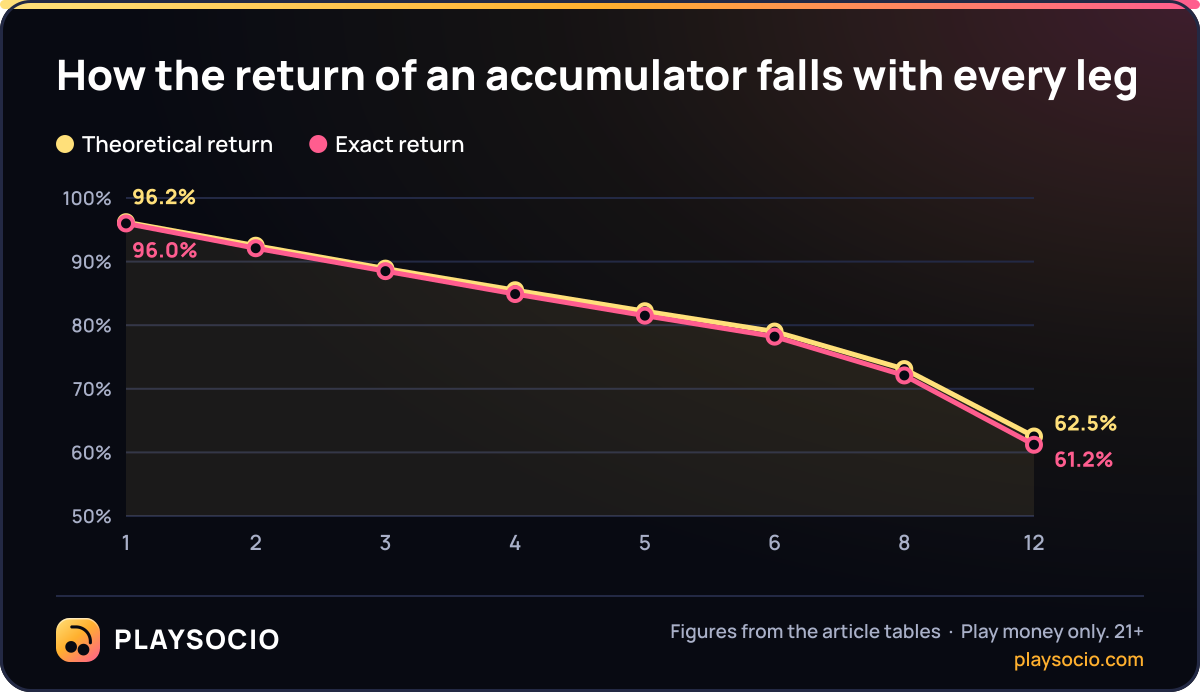
The coins are play money with no value outside the game. You build accumulators in coin betting. For what the margin means in each market see the margin article.
How do the prices multiply?
An accumulator wins only if every leg wins, and it pays the product of the prices. Two legs at 2.00 give 4.00. The chance that both win is 50% × 50% = 25%, and 1 / 4.00 = 25% agrees. With no margin an accumulator would not change the average outcome, only the variance.
With a margin, every price is a little shorter than the “fair” one. If each leg returns 0.9615, the product of n legs returns 0.9615 to the power n. The third column of the table shows the exact result, slightly lower than theory because prices are cut to two decimals.
What does the simulation say, and how far can you trust it?
The simulation shows the same decline, but with heavy noise from 4 legs up. The reason is that accumulators rarely win, and the few wins are very large. At 5 legs the standard error is 4.9 percentage points, and at 8 or 12 legs a simulation of 200,000 accumulators gives no usable figure: at 12 legs none won, and at 10 legs the standard error (87 points) exceeds the measurement.
So we present two measures. The exact calculation is the average 1X2 return (95.99%) raised to the power n, and it comes from the full distribution of scorelines with no randomness. The simulation confirms the test set-up is right, and it is only worth reading while the standard error is small.
How hard is an accumulator built from favourites?
Over the 132 matches of the season, the 1X2 favourite has an average price of 1.934 and an average chance of 51.6%. If you take the favourite in every leg:
| Legs | Total price | Chance of winning | About 1 in |
|---|---|---|---|
| 2 | 3.74 | 26.6% | 4 |
| 4 | 13.99 | 7.1% | 14 |
| 6 | 52.34 | 1.9% | 53 |
| 8 | 195.80 | 0.5% | 199 |
| 12 | 2,739.82 | 0.04% | 2,805 |
The figures are the favourite’s average over the 132 matches raised to the power n. They show the order of magnitude and describe no particular slip.
What do our numbers show?
Where the numbers come from: 200,000 random accumulators per row of the first table, with a random match and a random 1X2 selection in every leg and the result drawn from the same scoreline grid that priced the match. We also ran an exact calculation over the 132 matches of the virtual league season (November 2026). For legs 1 to 4 the two methods agree within one to two standard errors. At 5 and 6 legs the simulation comes out lower, but with standard errors of 4.9 and 7.8 points it does not differ statistically from the exact calculation.
The book’s rules for accumulators: leg prices from 1.01 to 1,000, up to 12 legs, a stake of 10 to 2,000 coins and a maximum payout of 500,000. Two legs from one match are not allowed. At the maximum stake the payout reaches the cap at a price of 250, so in a 12-leg favourites accumulator the cap removes most of the top payout.
What changes with the bet builder?
A combination within one match is priced from the joint probability, not the product, with a margin of 8% plus 2% for each leg beyond two, up to 20%. At 2 legs the return is 92.6%, at 4 legs 89.3% and at 6 legs 86.2%. Here the margin grows linearly and starts higher, while in an accumulator it multiplies.
How does a system differ from an accumulator?
A system plays every combination of k selections out of n. A “2 from 3” system with three selections at 2.00 and a stake of 90 coins splits the amount into three lines of 30 coins. Each line is a two-leg accumulator at 4.00.
| How many selections win | Lines that win | Return |
|---|---|---|
| 3 | 3 | 360 |
| 2 | 1 | 120 |
| 1 or 0 | 0 | 0 |
The system still pays after one losing selection, yet every line carries the margin. Each line is a two-leg accumulator, with an exact return of 92.1% on the 1X2 of 132 matches, so on average the system returns what a two-leg accumulator does. Lines multiply fast: from 8 selections, which is the book’s limit, a “4 from 8” system has 70 lines.
How do you repeat the calculation?
The numbers in this article come from a simulation and an exact calculation of the virtual book. Both take about 20 seconds to run and are repeatable, so the same figures come out every time. If the book’s settings change, the tables change with them and the article is rewritten with a new modified date.
The limits: the simulation runs on the model of the virtual book and says nothing about any real league. The 8-leg and 12-leg rows rest on the exact calculation alone, because the simulated runs are too noisy to use. The figures use the settings of November 2026. If a number here disagrees with our latest run, the run is right and we correct the article and note the change on this page. Coins are play money with no cash value, and the game is for 21+.
Sources
Frequently asked questions
Why does the return fall so fast with more legs?
Because each leg multiplies the return by 0.9615 (a 4% margin). With n legs the average return is 0.9615 to the power n: 88.9% for 3 legs and 62.5% for 12.
Can I put two selections from the same match in an accumulator?
No. Selections from one match are correlated, so the book does not allow them in an accumulator. Combinations from one match have their own tool with its own margin.
What is the most an accumulator can pay?
500,000 coins, with a stake of at most 2,000 coins and at most 12 legs. At the maximum stake, odds up to 250 are paid in full.
Do accumulators make up for the margin?
No. An accumulator does not improve the expected value. It raises the cost and the uncertainty.
About the author
Game Math Desk Probability and simulation
The people who build and check the maths of our games: paytables, reel weights, probability checks and volatility.
Coins have no cash value. 21+ only. Play money only, no real-money gambling, no prizes, no cash-out.