Tavli: Portes, Plakoto, Fevga10 min read
Free backgammon online: Portes, Plakoto or Fevga first?
Free backgammon online with play-money coins: what the three Greek variants are, how they differ from the international game, and which to learn first.
By Game Math Desk Updated:
Contents
- What does free backgammon online mean here?
- What is Greek tavli, and how is it different from international backgammon?
- Which variant should I learn first?
- How do I know the dice are fair?
- How do the dice work? The 36 combinations
- What do our numbers show?
- How is a 5-point match counted?
- What should I do in my first game?
- What are the common mistakes?
- How do I play responsibly?
- What are the limits of this article?
To play backgammon online for free, start with Portes, the international game, where you need 167 pips to bear off all 15 checkers. If you want a simpler start, try Plakoto first. All three Greek variants are free here and use play-money coins with no cash value.
| Item | Portes | Plakoto | Fevga |
|---|---|---|---|
| What happens to a lone checker | It is hit | It is pinned | The point is closed to you |
| Pips to bear off everything | 167 | 360 | 360 |
| Average turns per player (bots) | 26.4 | 45.8 | 47.6 |
| Match length | 1 to 11 points | 1 to 11 points | 1 to 11 points |
| Doubling cube | Optional | No | No |
| Cost | Free, play-money coins | Free, play-money coins | Free, play-money coins |
You can open each game from its page: Portes, Plakoto and Fevga. The rule-by-rule comparison lives in the article on the differences between the three variants. This one is about where and how to play for free and which to pick first.
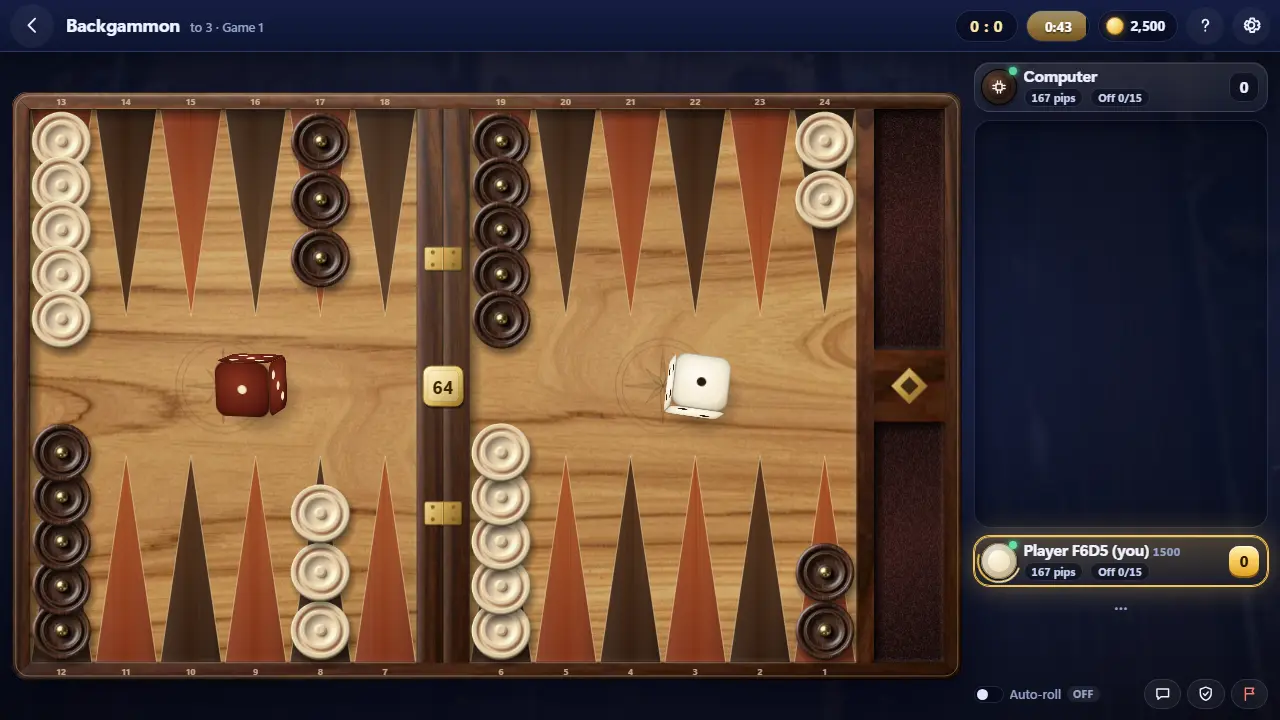
What does free backgammon online mean here?
You play with play-money coins. You do not stake money and you cannot win any, because the coins have no cash value. Playsocio is a social casino with no real-money gambling, and the games are for adults aged 21 and over (see what a social casino is).
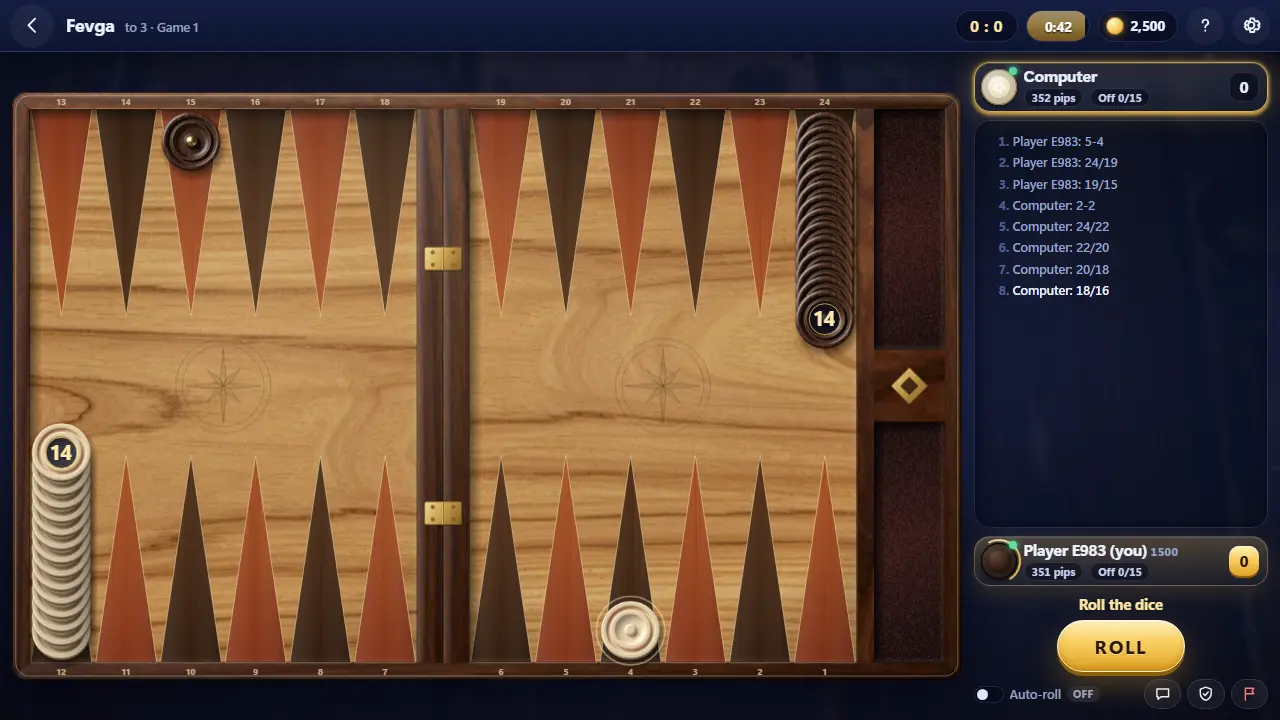
There is one game for each variant. A match runs to 1, 3, 5, 7, 9 or 11 points, and whoever reaches the target first wins. You can play against bots at three levels (easy, medium, strong), and the article on bot strength shows how each plays. Match results feed a rating, explained in the article on backgammon ratings.
What is Greek tavli, and how is it different from international backgammon?
In Greece, tavli is the name of the whole family. Portes is what the rest of the world calls backgammon. Plakoto and Fevga are two other games played on the same board with the same 15 checkers per side, 24 points and two dice. The Wikipedia article on Tavli describes the family, and the history of tavli traces where it comes from.
Compared with international backgammon, Plakoto and Fevga drop the hitting game. Nothing is sent to the bar in either one. In Plakoto you pin a lone enemy checker by landing on it. In Fevga both players run the same way round the board, and any point holding an enemy checker is closed.
| Portes | Plakoto | Fevga | |
|---|---|---|---|
| Direction | Opposite | Opposite | Same for both |
| Start | Four points (2, 5, 3, 5 checkers) | All 15 on one point | All 15 on one point |
| Lone enemy checker | Hit, goes to the bar | Pinned, stays in place | Point is closed |
| Bar | Yes | No | No |
| Scoring | 1, 2 (gammon), 3 (backgammon) | 1, 2 (mars) | 1, 2 (mars) |
| Special rules | Doubling cube, Crawford rule | Stalemate after 8 passes | First-checker rule, no six in a row |
One-by-one guides exist for each: Portes step by step, how to play Plakoto and how to play Fevga.
Which variant should I learn first?
It depends on what you know already.
- If you have played backgammon before, start with Portes. It has the most written help, the shortest game (167 pips instead of 360) and the doubling cube if you want it later. The beginner material starts there: rules for beginners and first strategy.
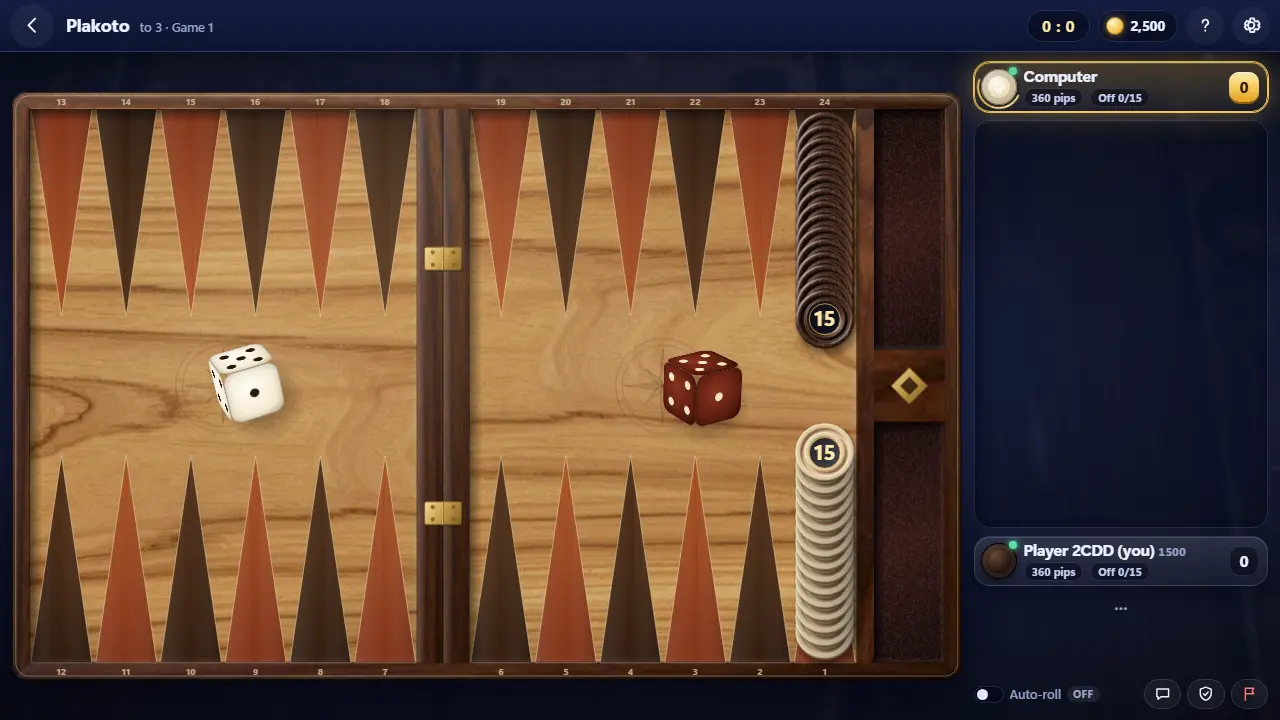
- If you have never played and four starting points feel like a lot, Plakoto has the simplest start: one stack, no bar and no cube. The price is a game that runs close to twice as long.
- Fevga is third. It has the most rules to remember (the first-checker rule, no six points in a row) and rewards you once you have felt what blocking is like.
We suggest the order Portes, Plakoto, Fevga. A first game against the easy bot in Portes shows you how checkers move, and the other two change a few rules on the same board. All three are free, so you can try each of them.
How do I know the dice are fair?
Before the first die is rolled the server publishes a commitment, the sha256 of a secret key. When the match ends it reveals the key. You can check that the key matches the commitment and recompute every die, so a die cannot be changed mid-match without showing.
The mechanism and a frequency test on 600,000 dice are in the article on whether online tavli dice are rigged. We do not claim any outside certification. The check relies on code you can run yourself.
How do the dice work? The 36 combinations
Two dice have 36 combinations if you tell the first die from the second. These are exact computations.
| Roll | Combinations | Probability |
|---|---|---|
| One specific double (for example 4-4) | 1 | 1/36 = 2.8% |
| Any double | 6 | 6/36 = 16.7% |
| One specific non-double pair (for example 6-1) | 2 | 2/36 = 5.6% |
| All non-doubles | 30 | 30/36 = 83.3% |
| A specific number on at least one die | 11 | 11/36 = 30.6% |
| Total of 7 | 6 | 6/36 = 16.7% |
A double is played four times. One die averages 3.5 pips and two dice 7, but with doubles a roll averages 49/6, or 8.17 pips. That gives a minimum of 20.4 rolls (167 ÷ 8.17) to bear off in Portes and 44.1 (360 ÷ 8.17) in the other two, as the pip count article shows.
A worked example: in Portes, a lone checker 6 pips in front of an enemy checker is hit by 17 of the 36 rolls, or 47.2%. At 7 pips it is only 6 of 36 (16.7%). That gap is why experienced players avoid leaving blots at distance 6, and the article on blots covers it. For more on basic probability, see probability basics for games.
What do our numbers show?
We played 3,000 games per variant, medium bot against medium bot, one-point games with no doubling cube.
| Portes | Plakoto | Fevga | |
|---|---|---|---|
| Single wins | 68.2% | 64.0% | 66.1% |
| Gammons / mars | 24.8% | 36.0% | 33.9% |
| Backgammons | 7.0% | 0% (not in the game) | 0% (not in the game) |
| Average turns per player | 26.4 | 45.8 | 47.6 |
| Points per game (average) | 1.39 | 1.36 | 1.34 |
| White wins | 48.9% | 49.2% | 50.2% |
| Player who moves first wins | 49.6% | 50.7% | 52.6% |
Engine data: 3,000 games per variant (9,000 in all) with the platform’s backgammon package, medium bot against medium bot, one-point games, fair dice with a separate stream per game, fixed seed (5000 to 7999), November 2026. Bots do not play like people, so the numbers show tendencies. With 3,000 games the margin of error on a rate near 50% is about ±1.8 points.
These figures differ a little from the ones in our other articles because the sample is different. The gammon article and the differences article use 2,000 games per variant with other dice (68.3% single wins, 24.6% gammons and 7.2% backgammons in Portes), and the first-move article uses 6,000. The gaps are within the margin of error and the conclusions hold. Plakoto and Fevga end in a mars in roughly one game in three and take about twice as many turns as Portes. White has no steady edge, and the starter’s edge is inside the margin of error in Portes and Plakoto. In Fevga the starter won 52.6%, just outside it, as in the first-move article. For how much of this is luck and how much skill, see luck or skill in backgammon.
How is a 5-point match counted?
A worked example. You play a 5-point match in Portes with no doubling cube. You win the first game with a single win (1 point), lose the second to a gammon (your opponent takes 2) and win the third with a backgammon (3 points). The score is 4-2 in your favour, and you need 1 more point. In Plakoto and Fevga the same game could be worth 2 points at most, because there is no backgammon.
That is why a game is worth a little over one point on average. In our simulations it is 1.39 points in Portes, 1.36 in Plakoto and 1.34 in Fevga. For more on match scores, see the article on 5 and 7 point matches.
What should I do in my first game?
- Pick the easy bot and a 1-point match. A game with no pressure teaches more than an 11-point match.
- Read the rules of your chosen variant once (the guides are above).
- Roll and play both dice. If only one can be played, you must play the larger.
- In Portes, before leaving a lone checker, count its distance from enemy checkers. In Plakoto, ask whether your point can be pinned. In Fevga, check which points are closed in front of you.
- When all 15 checkers are in your home board you start bearing off. See bearing off.
- After the game, check whether you lost a gammon or mars. If so, the problem was usually your position and not the dice.
What are the common mistakes?
Most beginner mistakes are shared by all three variants. One is playing the first die you see instead of thinking about the whole roll. Another is mixing up the rules: a pin in Plakoto is not a hit, and the pinned checker does not go back to the start. A third is forgetting the match score and playing for a gammon when one point is enough.
Portes has its own list in the article on common mistakes in Portes. On etiquette, do not stall. Nobody can touch the dice anyway, since the server rolls them and they can be checked.
How do I play responsibly?
The coins have no cash value and the games are for adults aged 21 and over. Backgammon here is entertainment, and the only real cost is your time. You can set time and coin limits, as the article on setting limits explains. If a game takes more time than you want to give it, take a break. For help, see where to find help.
What are the limits of this article?
The simulation figures come from bots, not people, and the rules are the ones our engine implements. For Fevga, sources differ on exactly where the first-checker rule ends, and we use the opponent’s first quadrant. You can check the basics against Backgammon Galore and Wikipedia. If you find a mistake, tell us and we will correct it.
Create a free account or play Portes free. The coins are play money with no cash value, and the game is for adults aged 21 and over.
Sources
Frequently asked questions
Can I play backgammon online for free?
Yes. Portes (international backgammon), Plakoto and Fevga are free to play with play-money coins that have no cash value. The games are for adults aged 21 and over.
What is Greek tavli?
Tavli is the Greek name for a family of three backgammon games played on the same board: Portes, which is the international backgammon, plus Plakoto and Fevga. They share 15 checkers per side, 24 points and two dice.
Which variant should a beginner play first?
If you already know backgammon, start with Portes. If you want the simplest start, Plakoto has no bar and no doubling cube and all checkers begin on one point. Fevga adds the most special rules.
How long does a game last?
In our bot simulations, an average of 26.4 turns per player in Portes, 45.8 in Plakoto and 47.6 in Fevga. People play more slowly, so treat these as a guide.
How do I know the dice are fair?
Before the first die is rolled the server publishes a commitment, the sha256 of its secret key. When the match ends it reveals the key, so you can recompute every die and check nothing changed.
How many points is a match?
Matches run to 1, 3, 5, 7, 9 or 11 points. A single win is 1 point, a gammon or mars is 2, and a backgammon is 3 in Portes only.
About the author
Game Math Desk Probability and simulation
The people who build and check the maths of our games: paytables, reel weights, probability checks and volatility.
Coins have no cash value. 21+ only. Play money only, no real-money gambling, no prizes, no cash-out.